How do you feel about money?
I see money as a tool for freedom, growth, and creating opportunities, not just something to spend.
Insights and Thoughts
I see money as a tool for freedom, growth, and creating opportunities, not just something to spend.
Personal finance management means planning and controlling how you earn, spend, save, and invest your money. Many people earn money but still face financial problems because they don’t manage it properly. Good money management helps you reduce stress, avoid debt, and build a strong financial future.
1. Understand Your Income and Expenses
The first step in personal finance is knowing how much money you earn and where it goes.
Write down your monthly income
Track daily and monthly expenses
Identify unnecessary spending
When you understand your cash flow, you can make smarter fi...
nancial decisions.
2. Create a Simple Budget
A budget is a financial plan for your money.
A simple rule you can follow:
50% for needs (rent, food, bills)
30% for wants (entertainment, shopping)
20% for savings and investments
Budgeting helps you live within your income and avoid overspending.
3. Save Money Regularly
Saving is not about how much you earn, but how much you keep.
Save at least 10–20% of your income
Build an emergency fund for unexpected expenses
Keep savings separate from spending money
Small savings today can become big wealth tomorrow.
4. Control Debt and Avoid Bad Loans
Debt can destroy your financial life if not managed properly.
Avoid unnecessary loans
Pay high-interest debt first
Use credit cards wisely
Good debt (education, business) can help you grow, but bad debt creates problems.
5. Start Investing Early
Investing helps your money grow faster than saving alone.
Popular investment options include:
Stocks and mutual funds
Fixed deposits
Real estate
Digital assets (with proper knowledge)
The earlier you start, the more benefit you get from compound growth.
6. Set Financial Goals
Clear goals give direction to your money.
Examples:
Short-term: emergency fund, travel
Long-term: house, business, retirement
Write your goals and review them regularly.
Personal finance management is a life skill everyone should learn. With proper budgeting, saving, smart investing, and discipline, anyone can achieve financial stability and freedom. Start managing your money today—your future self will thank you.
Artificial Intelligence, or AI, means machines that can think, learn, and make decisions like humans. Today, AI is not only used by big companies—it is used by normal people every day. From mobile phones to online banking, AI is quietly making our life easier, faster, and smarter.
1. AI in Smartphones and Daily Apps
AI is already inside your phone.
Examples:
Face unlock and fingerprint recognition
Voice assistants like Google Assistant and Siri
Camera AI that improves photo quality
Keyboard predictions and auto-correct
AI helps smartphones understand user behavior and g...
ive better results.
2. AI in Education and Learning
AI is changing how students learn.
Online tutors and learning apps
Personalized study plans
Language learning tools
Instant doubt-solving chatbots
Students can learn anytime, anywhere, at their own speed using AI.
3. AI in Business and Work
AI helps businesses save time and increase profit.
Customer support chatbots
AI tools for marketing and content writing
Data analysis and sales prediction
Automation of repetitive tasks
Even small businesses can use AI to compete with big companies.
4. AI in Healthcare
AI is helping doctors and patients.
Disease detection and diagnosis
Medical report analysis
Appointment scheduling
Fitness and health tracking apps
AI improves accuracy and reduces human error in healthcare.
5. AI in Personal Finance and Money Management
AI helps people manage money better.
Expense tracking apps
Investment analysis tools
Fraud detection in banking
Budget planning suggestions
AI makes financial decisions smarter and safer.
6. AI for Content Creation and Creativity
AI is supporting creativity, not replacing it.
Writing blogs and scripts
Designing graphics and videos
Music and voice generation
Social media content ideas
Creators can work faster and focus on ideas instead of hard work.
7. Challenges of Using AI
AI also has some challenges.
Data privacy concerns
Over-dependence on technology
Job replacement fears
Ethical issues
That’s why AI should be used wisely and responsibly.
AI is already part of real life, and its use will grow even more in the future. When used correctly, AI can improve productivity, learning, health, and income. Instead of fearing AI, we should learn how to use it smartly to build a better future.
If you’re struggling with money, society quickly labels you as “bad with finances.”
But here’s the truth:
You’re not bad with money. You’re trapped.
Trapped in a system that teaches you how to work for money but never how to make money work for you.
This blog breaks that illusion and shows the real reason most people stay financially stuck.
— Nirajan Dangi
1. The System Was Never Built for Financial Freedom
From childhood, we are taught:
Go to school
Get good grades
Get a job
Work for 40+ years
But no one teaches:
How money grows
How assets work
How ...
inflation steals savings
How rich people think differently
The system trains employees, not investors.
2. Living Paycheck to Paycheck Is Not a Personal Failure
Millions of hardworking people still struggle every month.
Why?
Fixed salary, rising expenses
No financial education
No time to build skills
Fear of risk
This is not laziness.
This is financial entrapment.
3. Schools Teach Subjects, Not Survival
You learn:
Math
History
Science
But not:
Budgeting
Investing
Taxes
Debt management
Real life money rules are learned outside the classroom.
4. You’re Trapped in One Income Stream
Most people depend on one source of income.
When that income stops:
Stress begins
Fear increases
Dreams pause
Smart people focus on:
Skills
Side income
Digital leverage
Investments
One income = risk. Multiple income = freedom.
5. Fear Is the Invisible Cage
People stay stuck because of:
Fear of failure
Fear of judgment
Fear of losing money
But staying the same is the biggest risk.
Growth begins when fear ends.
6. Wealth Is a Mindset Before It’s Money
Poor mindset says:
“Money is evil”
“I’m not lucky”
“Rich people cheat”
Wealth mindset says:
“Money is a tool”
“I can learn”
“Skills create income”
Change your mindset, and your financial reality changes.
7. How to Break Free (Real Steps)
You don’t escape overnight—but you start today.
Practical steps:
Learn financial basics
Build one high-income skill
Start investing small
Use technology & AI
Create value, not excuses
Freedom is built daily, not instantly.
Conclusion
You are not broken.
You are not incapable.
You are not bad with money.
You’re trapped in a system that profits from your ignorance.
Once you learn the rules of money, the trap disappears.
— Nirajan Dangi
financial freedom
money mindset
personal finance
why people stay poor
how money works in real life
financial education
In today’s digital world, age is no longer a barrier to earning money. If you are a student under 20 years old, ChatGPT can be a powerful tool to help you build skills, start online work, and earn income from anywhere in the world. Below are five practical and beginner‑friendly ways students are already using ChatGPT to make money globally.
1. Freelance Writing & Content Creation
Many websites, blogs, and businesses need content every day. With the help of ChatGPT, students can:
Write blog posts and articles
Create website content
Rewrite or proofread existing text
Generate s...
ocial media captions
How to start:
Learn basic English writing skills
Use ChatGPT to create outlines and drafts
Join platforms like Fiverr, Upwork, or Freelancer
Earning potential: 5–50 per article (can grow with experience)
2. Social Media Management
Small businesses and influencers need help managing their social media pages. ChatGPT can help students:
Create daily post ideas
Write captions and hashtags
Plan content calendars
Reply to comments professionally
How to start:
Choose one platform (Instagram, Facebook, TikTok)
Practice creating posts using ChatGPT
Offer services to local or online businesses
Earning potential: 50–300 per month per client
3. Online Tutoring & Homework Help
If you are good at subjects like English, Math, Science, or Computer basics, ChatGPT can support you in:
Explaining concepts clearly
Creating practice questions
Preparing lesson notes
How to start:
Register on tutoring websites or use social media
Help junior students or beginners
Use ChatGPT for lesson preparation (not cheating)
Earning potential: 5–20 per hour
4. Digital Product Creation
Students can create and sell digital products with ChatGPT, such as:
E‑books
Study notes
Resume templates
Motivational journals
How to start:
Identify a problem students face
Use ChatGPT to draft content
Sell on platforms like Gumroad or Etsy
Earning potential: Passive income (sell once, earn many times)
5. YouTube Scripts & Blogging
Many YouTubers and bloggers need scripts and ideas. ChatGPT can help students:
Write YouTube video scripts
Generate blog ideas
Create SEO‑friendly content
How to start:
Choose a niche (education, motivation, tech)
Offer scriptwriting services or start your own blog
Monetize through ads and affiliate links
Earning potential: 10–100 per script or long‑term ad income
Final Thoughts
ChatGPT is not a shortcut to instant money, but it is a powerful learning and earning assistant. For students under 20, the key is to:
Learn skills
Be consistent
Use ChatGPT ethically and creatively
If students start early, they can build global‑level income skills while studying and prepare for a successful future.
An MBA degree is expensive, time-consuming, and not always practical. Many successful entrepreneurs and professionals never went to business school, yet they understand business deeply. This idea led to the concept of The Personal MBA learning the most important business skills on your own, without a formal MBA program.
The Personal MBA focuses on real-world business knowledge, not just theory.
What Is The Personal MBA?
The Personal MBA is a self-education system that teaches core business concepts such as:
Marketing
Sales
Finance
Operations
Strategy
Leadership
In...
stead of spending years and huge money on a degree, you learn only what actually matters in business.
Why The Personal MBA Is Gaining Popularity
1. Traditional MBA Is Expensive
MBA programs can cost lakhs or even crores. The Personal MBA costs little to nothing and offers practical knowledge.
2. Real-World Skills Over Theory
The Personal MBA focuses on:
How businesses really work
How money flows
How decisions are made
This makes it more useful for entrepreneurs and professionals.
3. Learn at Your Own Pace
You can learn anytime, anywhere no exams, no pressure, no classrooms.
Core Skills You Learn in The Personal MBA
1. Marketing and Value Creation
Understanding customer needs and creating value is the heart of business.
Key topics:
Customer psychology
Branding
Pricing strategies
2. Sales and Communication
No sales = no business.
Learn:
How to sell ethically
Negotiation skills
Persuasion techniques
3. Finance and Money Management
You don’t need to be a finance expert, but you must understand:
Cash flow
Profit and loss
Budgeting
Investment basics
4. Operations and Systems
Great businesses run on systems, not stress.
Learn:
Process optimization
Productivity
Automation
5. Strategy and Decision-Making
The Personal MBA teaches you how to think clearly and make smart decisions under uncertainty.
Who Should Follow The Personal MBA?
The Personal MBA is ideal for:
Entrepreneurs
Startup founders
Freelancers
Students
Professionals who want growth
Anyone who wants business knowledge without a degree
How to Build Your Own Personal MBA
1. Read the Right Books
Focus on business classics and practical guides.
2. Learn From Real Businesses
Study successful companies and failed startups.
3. Apply What You Learn
Practice is more important than certificates.
4. Use Online Tools and AI
AI tools can speed up learning, analysis, and decision-making.
The Personal MBA
Business skills
Learn business without MBA
Business education
Entrepreneurship
Finance and marketing basics
Conclusion
The Personal MBA proves that you don’t need a formal degree to understand business. With curiosity, discipline, and the right resources, anyone can master business fundamentals. In today’s fast-changing world, self-education is the most powerful MBA you can earn.
Why Bitcoin 2050 Matters
Bitcoin is no longer just a digital currency it is a global financial revolution. What began in 2009 as an experiment is now challenging governments, banks, and traditional money itself.
By 2050, Bitcoin could reshape wealth, power, and freedom in ways most people cannot imagine today.
Here are 10 shocking predictions about Bitcoin in 2050 that could change everything.
1. Bitcoin Could Be Worth 10–50 Million per Coin
With a fixed supply of 21 million coins, increasing global adoption, and inflation of fiat currencies, Bitcoin’s price could reach unimagin...
able levels.
By 2050, owning 0.1 BTC may be considered a symbol of extreme wealth.
2. Governments Will Hold Bitcoin as a Reserve Asset
Just like gold today, Bitcoin could become a global reserve asset.
Central banks may store BTC
Countries may compete to accumulate it
Bitcoin could back national currencies
Those who buy early will benefit the most.
3. Banks Will Be Forced to Adapt or Die
Traditional banks may lose control over money.
By 2050:
People may store wealth in Bitcoin wallets, not banks
Loans may be issued using smart contracts
Banks become service providers, not controllers
Bitcoin removes middlemen.
4. Bitcoin Will Power a New Global Financial System
Bitcoin may become the base layer of global finance:
Borderless payments
Instant global settlements
No currency exchange manipulation
A farmer in Nepal and a business owner in New York could transact directly.
5. Fiat Currencies Will Continue to Lose Value
Most governments print money endlessly.
By 2050:
Inflation could destroy purchasing power
Savings in fiat may become risky
Bitcoin becomes a hedge against corruption and mismanagement
Bitcoin rewards discipline. Fiat rewards debt.
6. Bitcoin Will Create a New Class of Super-Elites
Early Bitcoin believers could become the new global elite.
Bitcoin millionaires
Bitcoin billionaires
Bitcoin trillionaires
This will shift power away from traditional elites toward digital-native visionaries.
7. Mining Will Be 100% Green or Highly Efficient
Bitcoin mining will evolve:
Powered by renewable energy
Used to stabilize power grids
Integrated with solar, hydro, and nuclear energy
Bitcoin could actually accelerate green energy adoption.
8. Owning Bitcoin Will Be a Human Rights Issue
In some countries, access to Bitcoin may mean:
Financial freedom
Protection from confiscation
Escape from hyperinflation
Bitcoin could become a tool for freedom, not just profit.
9. Most People Will Still Be Late
Despite all warnings:
Many will ignore Bitcoin
Many will buy at the top
Few will truly understand it
History repeats itself.
10. Bitcoin Will Redefine Money Itself
By 2050, people may ask:
“Why did we ever trust money that could be printed infinitely?”
Bitcoin introduces:
Mathematical trust
Digital scarcity
Permissionless ownership
Money will never be the same.
Final Truth: The Real Shock
The biggest shock is not Bitcoin’s price.
The real shock is this:
Bitcoin gives power back to individuals.
Those who understand it early will shape the future. Those who ignore it will live in the system others designed.
Call to Action
The question is not if Bitcoin will change the world.
The question is:
Will you be ready before 2050?
Chovar is a historic and scenic destination located on the southwestern edge of the Kathmandu Valley. It holds great cultural, religious, and geographical significance, as it is the point where the Bagmati River flows out of the valley through the Chovar Gorge.
Home to the famous Chovar Cave and the sacred Adinath Loknath Temple, Chovar offers a unique blend of history, spirituality, and natural beauty. The surrounding green hills, peaceful atmosphere, and panoramic valley views make it an ideal escape from the busy city life while still being close to the heart of Kathmandu.
Chovar is p...
erfect for sightseeing, short hikes, photography, spiritual visits, and family outings. Visitors can enjoy breathtaking views of the Kathmandu Valley, especially during sunrise and sunset.
Chovar is a place where nature, history, and spirituality come together, offering a calm and memorable experience for every traveler.
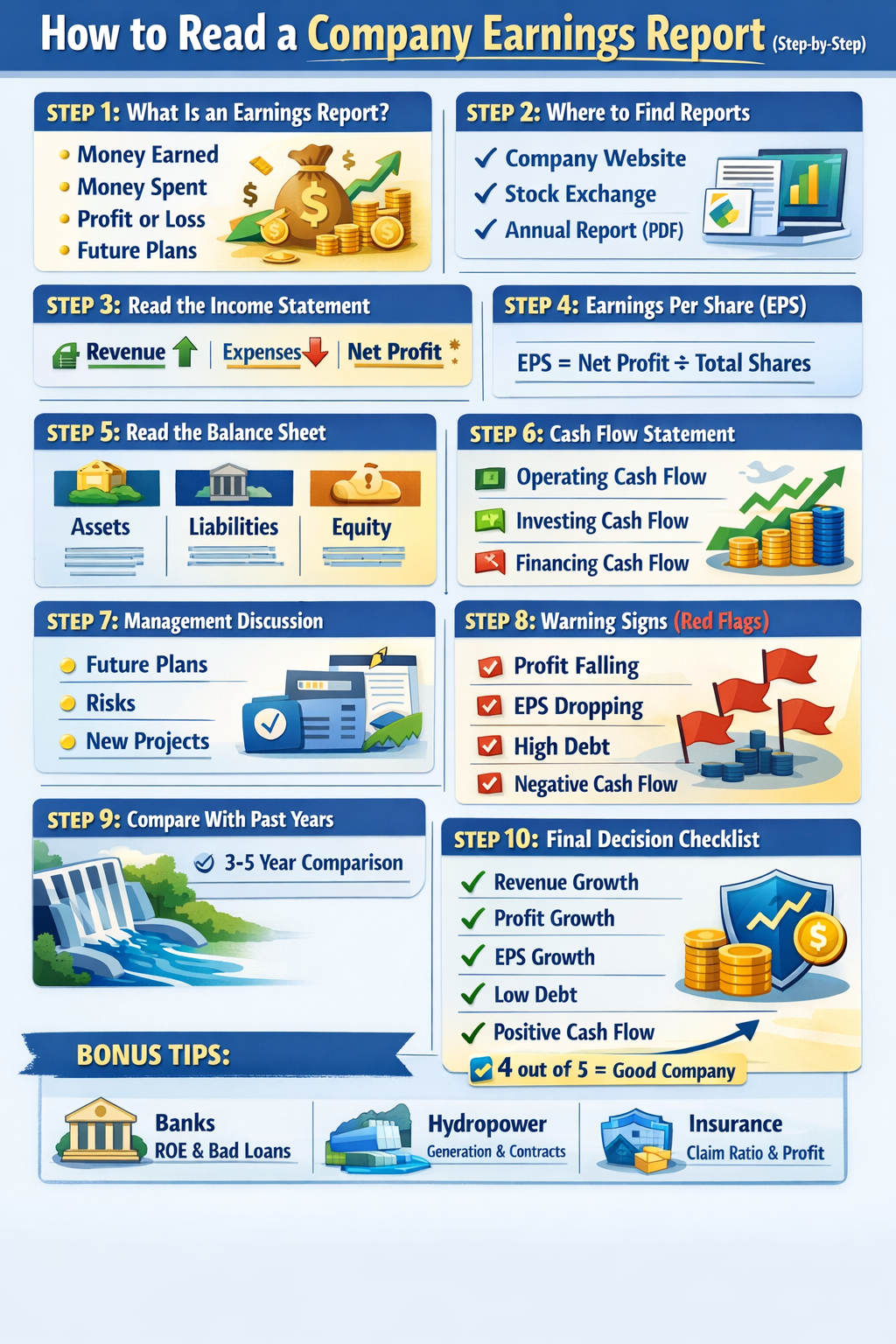
What Is an Earnings Report?
An earnings report shows a company’s financial performance.
It tells you:
How much money the company earned
How much it spent
Profit or loss
Future plans
Earnings reports are published:
Quarterly (every 3 months)
Annually (once a year)
Step 2: Where to Find Earnings Reports
You can find earnings reports on:
The company’s official website (Investor Relations)
Stock exchange website
Annual report (PDF)
Step 3: Read the Income Statement (Most Important)
Revenue / Sales
Revenue shows how much money the company made.
...
Revenue increasing = good sign
Revenue decreasing = warning
Example:
2024 Revenue: $100 million
2025 Revenue: $130 million → Growth
Expenses
Expenses are the company’s costs.
If expenses increase too fast, profit will fall.
Net Profit
Net profit is money left after all expenses.
Positive profit = good company
Negative profit = loss
Tip:
Profit growing for 3–4 quarters is a strong sign.
Step 4: Earnings Per Share (EPS)
EPS shows how much profit one share earns.
Formula:
Net Profit ÷ Total Shares = EPS
EPS increasing = very good
EPS decreasing = weak performance
Step 5: Read the Balance Sheet
Assets
Assets are what the company owns:
Cash
Land and buildings
Equipment
More assets = stronger company
Liabilities
Liabilities are company debts or loans.
High debt = risky
Low debt = safer
Equity
Equity is the owners’ actual value in the company.
Step 6: Cash Flow Statement (For Smart Investors)
Operating Cash Flow
Cash generated from daily business.
Must be positive
Investing Cash Flow
Money spent on new projects or machines.
Financing Cash Flow
Money from loans or issuing shares.
Step 7: Management Discussion
This section explains what company leaders say.
Look for:
Future plans
Business risks
Expansion strategy
New projects
Step 8: Warning Signs (Red Flags)
Revenue increasing but profit decreasing
EPS falling
Debt rising fast
Operating cash flow negative
Step 9: Compare With Past Years
Never check only one year.
Compare last 3–5 years
Compare with similar companies in the industry
Step 10: Final Decision Checklist
A good company usually has:
Revenue growth
Profit growth
EPS growth
Low debt
Positive cash flow
If 4 out of 5 are strong → Good company
Bonus Tips
Banks: Check ROE and bad loans
Hydropower: Check power generation and contracts
Insurance: Check claim ratio and profit
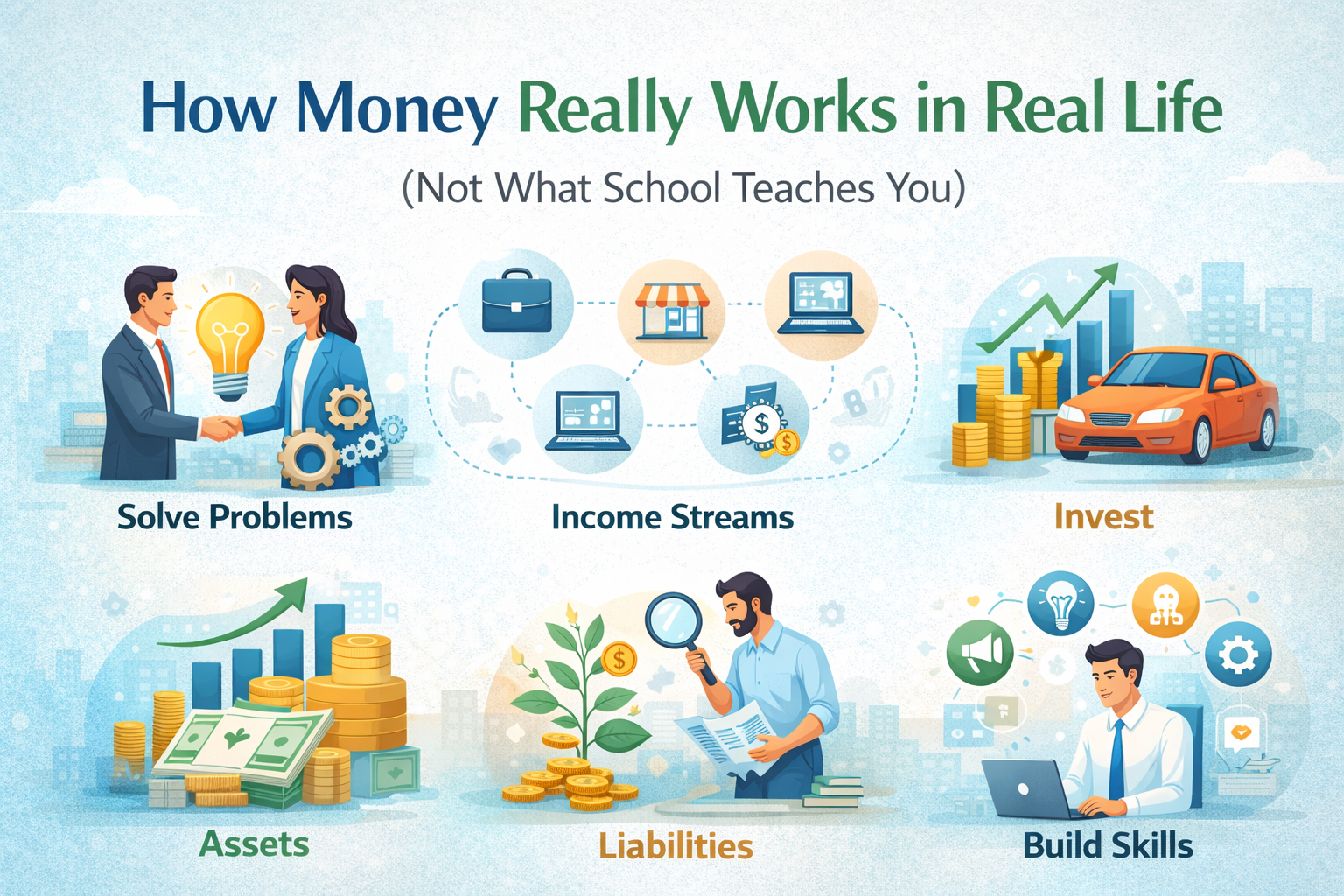
Most people go to school for years, but no one teaches them how money really works.
In real life, money follows different rules rules used by business owners, investors, and financially smart people.
1. Money Is Earned by Solving Problems
In real life, money comes from value, not degrees.
A shop earns money by selling convenience
A freelancer earns money by solving client problems
A business earns money by creating solutions
Rule: The bigger the problem you solve, the more money you earn.
2. Salary Is Only One Way to Make Money
Most people depend on one income sour...
ce a job.
Smart people build multiple income streams.
Common real-life income types:
Salary (job income)
Business income
Freelancing
Investments (stocks, crypto, real estate)
Online income (content, courses, AI tools)
Rule: Never depend on only one income source.
3. Saving Money Is Protection, Not Wealth
Saving money is important, but it does not make you rich.
Savings protect you in emergencies
Inflation slowly reduces saved money value
Rule: Save money for safety, invest money for growth.
4. Rich People Buy Assets, Poor People Buy Liabilities
This is a real-life money rule.
Assets (put money in your pocket):
Businesses
Stocks
Rental property
Skills that earn income
Liabilities (take money out):
Expensive gadgets
Luxury items bought on EMI
Cars for show, not income
Rule: Buy assets first, luxuries later.
5. Money Works for You Only When You Invest It
Money sitting idle does nothing.
Smart people invest money in:
Stock market
Businesses
Skills
Technology (AI, digital tools)
Rule: Make money work for you, even while you sleep.
6. Skills Are the New Currency
In real life, skills pay more than certificates.
High-income skills include:
Sales & marketing
Investing
AI tools usage
Content creation
Programming & automation
Rule: Skills bring money faster than degrees.
7. Mindset Decides Your Financial Future
Poor mindset:
“Money is evil”
“I can’t get rich”
“Risk is bad”
Rich mindset:
“Money is a tool”
“I can learn”
“Risk can be managed”
Rule: How you think about money decides how much you earn.
Conclusion
Money in real life is simple:
Solve problems
Build skills
Invest wisely
Control expenses
Think long term
You don’t need to be born rich you need financial education and action.
Start small. Start today.
Your money journey begins now.
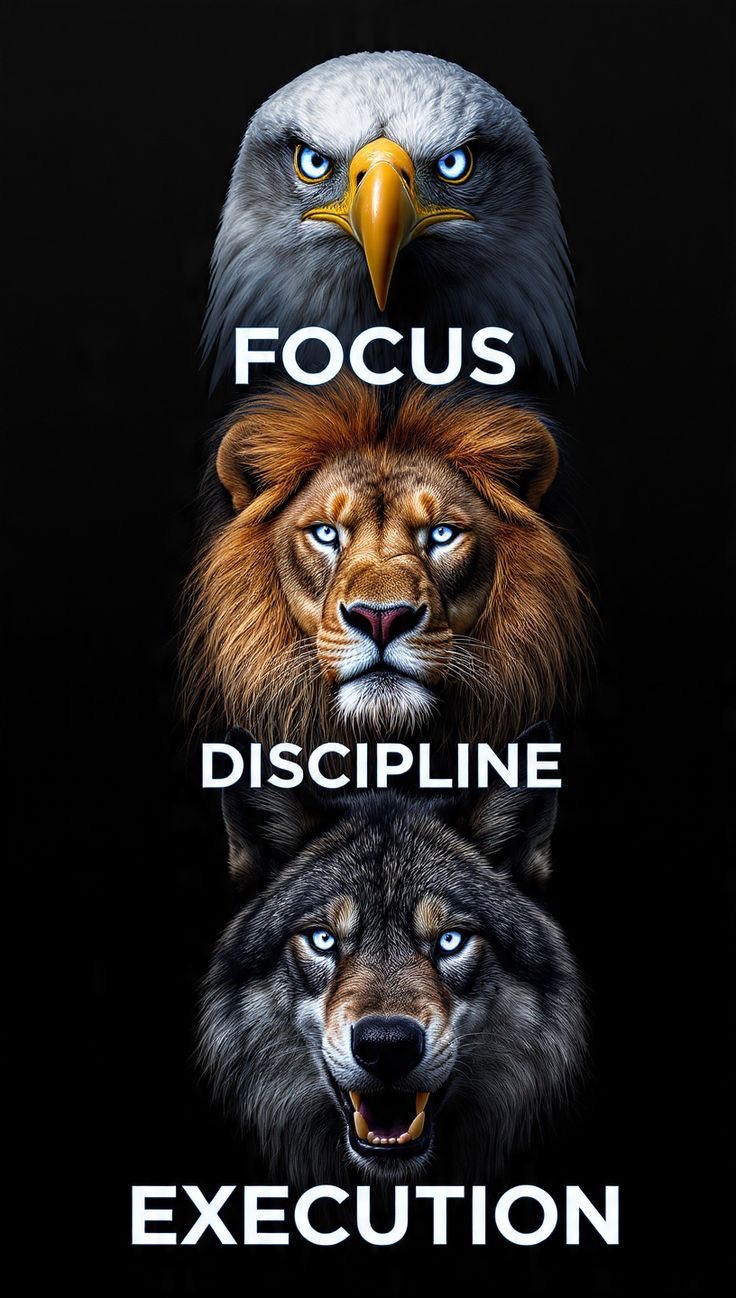
🦁 DISCIPLINA (Discipline)
Symbol: Lion
Discipline means doing what must be done, even when you don’t feel like it.
Wake up on time, every day
Study, work, train consistently
Control emotions, laziness, and distractions
The lion is calm, patient, and powerful.
It doesn’t rush, but it never quits.
Formula:
Discipline × Time = Success
🐺 EXECUÇÃO (Execution)
Symbol: Wolf
Execution means taking action, not just planning or dreaming.
Many people plan, few people act
Ideas are cheap, execution is rare
Wolves hunt as a team and finish the task
Execution is
S...
tarting today
Making mistakes
Learning fast
Completing the work
Execution creates results.
No action = no success.
Remember:
A small action today is better than a perfect plan tomorrow.
🦅 FOCO (Focus)
Symbol: Eagle
Focus means giving full attention to one goal.
Eagle sees one target, ignores everything else
No distraction, no noise, no fear
One direction, one mission
In life:
Too many goals = no progress
One clear goal = fast growth
Focus multiplies power.
Where focus goes, energy flows.
THE COMPLETE POWER FORMULA
Discipline → controls your life
Execution → creates results
Focus → multiplies speed
Discipline + Execution + Focus = Unstoppable Success