The 10 Richest People in the World
1. Elon Musk
2. Larry Page
3. Jeff Bezos
4. Sergey Brin
5. Michael Dell
6. Mark Zuckerberg
7. Larry Ellison
8. Jensen Huang
9. Steve Ballmer
10. Bernard Arnault
The world’s wealthiest individuals have built their fortunes through technology, e-commerce, luxury goods, finance, and other high-growth industries. Their stories demonstrate how innovative ideas, business ownership, investment, and long-term expansion can create extraordinary wealth.
According to the source, the following were the 10 richest people in the world as of August 1, 2026.
1. Elon Musk
Elon Musk is list...
ed as the richest person in the world. Born in South Africa, Musk studied in Canada before transferring to the University of Pennsylvania, where he earned degrees in physics and economics.
After entering Stanford University’s graduate physics program, Musk deferred his studies just two days later to pursue entrepreneurship. He launched Zip2, an early online navigation service, and later used part of the proceeds to establish X.com, an online payments company that was eventually sold to eBay and became part of PayPal.
In 2004, Musk became a major investor in Tesla Motors, later becoming CEO of the electric vehicle company. Tesla expanded beyond electric cars into energy-storage products, automotive accessories, and solar-power systems following its acquisition of SolarCity.
Musk is also the CEO and chief engineer of SpaceX, a company focused on space-launch technology.
Tesla joined the S&P 500 in December 2020, and Musk became the world’s richest person in January 2021, although the position has changed over time.
In 2022, Musk completed his acquisition of Twitter for approximately $44 billion. The transaction eventually gave him a controlling stake in the company.
Musk founded xAI in 2023, an artificial-intelligence company focused on developing AI technology to support scientific discovery. According to the source, X and xAI later became part of xAI Holdings, and SpaceX subsequently acquired xAI.
The source states that SpaceX went public on June 12, 2026, making Musk the world’s first trillionaire.
2. Larry Page
Age: 53
Residence: United States
Role: Co-founder and Board Member of Alphabet
Net Worth: $305 billion
Alphabet Ownership: 6%, valued at approximately $278 billion
Other Assets: Approximately $27 billion in cash
Larry Page began his journey toward extraordinary wealth while studying at Stanford University. In 1995, he and Sergey Brin developed an idea for improving the way information could be organized and extracted from the internet.
They created an early search-engine technology called Backrub, which evaluated relationships between web pages and links.
Page and Brin eventually founded Google in 1998. Page served as CEO during two different periods and later became a board member of Alphabet, Google's parent company.
Google became the dominant global search engine, while the company expanded into numerous other industries. Google acquired YouTube in 2006 and Android in 2005, later developing Android into one of the world's major mobile operating systems.
Google reorganized under Alphabet in 2015, creating a larger corporate structure for its various businesses and investments.
Page has also invested in emerging technologies, including space exploration, asteroid-mining projects, and flying-car companies.
3. Jeff Bezos
Age: 62
Residence: United States
Role: Founder and Executive Chair of Amazon
Net Worth: $290 billion
Amazon Ownership: 8.2%, valued at approximately $239 billion
Other Assets: Blue Origin, The Washington Post, Koru, and approximately $33 billion in cash
Jeff Bezos founded Amazon in 1994 after leaving investment firm D.E. Shaw. His original concept was an online bookstore, but Amazon eventually transformed into one of the world's largest e-commerce companies.
The company expanded far beyond books, developing a massive online marketplace and entering industries such as grocery, cloud computing, entertainment, logistics, and pharmaceuticals.
Amazon's growth strategy has relied heavily on diversification and acquisitions. One major example was its acquisition of Whole Foods in 2017.
Bezos took Amazon public in 1997 and became one of the world's wealthiest individuals as the company's market value increased dramatically.
In July 2021, Bezos stepped down as Amazon's CEO and became executive chair.
His other major projects include Blue Origin, a private aerospace company, and The Washington Post, which he purchased in 2013.
Bezos has also invested in large-scale personal projects, including the superyacht Koru.
4. Sergey Brin
Age: 52
Residence: United States
Role: Co-founder and Board Member of Alphabet
Net Worth: $283 billion
Alphabet Ownership: 6%, valued at approximately $256 billion
Other Assets: Approximately $27.2 billion in cash
Sergey Brin was born in Moscow and moved to the United States with his family when he was six years old.
While studying at Stanford University, Brin met Larry Page. Together, they developed the technology that eventually became Google.
Google was founded in 1998, and Brin later served as the company's president of technology. After Google reorganized under Alphabet in 2015, Brin continued in a leadership role before stepping down in 2019.
Google expanded into numerous technology markets, including search, cloud services, mobile operating systems, digital advertising, hardware, and online productivity tools.
Its Google Workspace ecosystem includes products such as Gmail, Google Drive, Google Calendar, Google Meet, Google Chat, Google Docs, Google Sheets, and Google Slides.
Brin has also supported philanthropic efforts, including research related to Parkinson's disease.
5. Michael Dell
Age: 61
Residence: United States
Role: CEO of Dell Technologies
Net Worth: $217 billion
Dell Ownership: 40%, valued at approximately $119 billion
Other Assets: Broadcom holdings, private investments, and approximately $48.9 billion in cash
Michael Dell began building his business while still in college. In 1984, he started selling upgraded computer systems directly to customers from his dorm room.
That small operation eventually became Dell Technologies, a major global company specializing in computing infrastructure and technology.
Dell's wealth is largely connected to his ownership of Dell Technologies and investments in Broadcom.
Dell Technologies previously owned VMware, which was spun off and later acquired by Broadcom. Dell's ownership interests were converted into shares of Broadcom, further increasing the value of his investment portfolio.
His story demonstrates how direct-to-customer business models, technology, ownership, and long-term investment can combine to create substantial wealth.
6. Mark Zuckerberg
Age: 42
Residence: United States
Role: CEO and Chair of Meta Platforms
Net Worth: $199 billion
Meta Ownership: 13%, valued at approximately $191 billion
Other Assets: Approximately $7.88 billion in cash
Mark Zuckerberg developed Facebook with fellow Harvard students Eduardo Saverin, Dustin Moskovitz, and Chris Hughes in 2004.
As Facebook expanded rapidly across universities and eventually around the world, Zuckerberg left Harvard to focus on the company.
Facebook later became Meta Platforms, reflecting the company's expansion beyond social networking.
Meta's portfolio includes major platforms and businesses such as Instagram, WhatsApp, and virtual-reality technology.
The company's primary revenue source is advertising, generated across its large global user base.
Zuckerberg and his wife, Priscilla Chan, also established the Chan Zuckerberg Initiative, which focuses on using technology and research to address major social and scientific challenges.
7. Larry Ellison
Age: 81
Residence: United States
Role: Co-founder, Chair, and CTO of Oracle
Net Worth: $181 billion
Oracle Ownership: 40%, valued at approximately $128 billion
Other Assets: Tesla equity and approximately $39.4 billion in cash
Larry Ellison was born in New York and later moved to California, where he worked as a computer programmer.
In 1977, Ellison co-founded Software Development Laboratories with Ed Oates and Bob Miner.
The company later developed Oracle, a commercial relational database system based on SQL. Its success transformed the company into one of the world's most important enterprise-software businesses.
Oracle eventually expanded into cloud computing, enterprise applications, databases, and other technology services.
Over the years, Oracle has also grown through major acquisitions, including Sun Microsystems and Cerner.
Ellison stepped down as Oracle's CEO in 2014 after decades of leadership but continued as chairman and chief technology officer.
He has also invested in other businesses and projects, including Tesla and various technology-related ventures.
8. Jensen Huang
Age: 63
Residence: United States
Role: CEO of NVIDIA
Net Worth: $166 billion
NVIDIA Ownership: Approximately 3.3%, valued at about $163 billion
Other Assets: Approximately $3.38 billion in cash
Jensen Huang is the co-founder and CEO of NVIDIA, one of the world's most influential semiconductor and artificial-intelligence companies.
Huang co-founded NVIDIA in 1993 with Chris Malachowsky and Curtis Priem.
The company initially became famous for graphics processors, but NVIDIA later became a central player in artificial intelligence and accelerated computing.
As demand for AI computing increased, NVIDIA's chips and technology became critical components of modern AI infrastructure.
A significant portion of Huang's personal wealth comes from his ownership of NVIDIA shares.
His rise illustrates how ownership in a company operating at the center of a rapidly expanding technological industry can create enormous personal wealth.
9. Steve Ballmer
Age: 70
Residence: United States
Role: Owner of the Los Angeles Clippers
Net Worth: $163 billion
Microsoft Ownership: Approximately 4%, valued at about $148 billion
Other Assets: Los Angeles Clippers, The Forum, Intuit Dome, Stagwell, and cash
Steve Ballmer joined Microsoft in 1980 after Bill Gates persuaded him to leave Stanford University's MBA program.
He became Microsoft's 30th employee and eventually succeeded Gates as CEO in 2000.
Ballmer served as Microsoft's CEO until 2014 and oversaw major developments during his tenure, including Microsoft's acquisition of Skype.
His wealth is primarily connected to his ownership of Microsoft shares.
After leaving Microsoft, Ballmer expanded his investments into sports and entertainment. In 2014, he purchased the Los Angeles Clippers for approximately $2 billion.
Ballmer's story shows how early employment, long-term equity ownership, leadership, and strategic investments can produce extraordinary wealth.
10. Bernard Arnault
Age: 77
Residence: France
Role: CEO and Chair of LVMH
Net Worth: $161 billion
LVMH Ownership: 49%, valued at approximately $133 billion
Other Assets: Approximately $28.4 billion in cash
Bernard Arnault is the chairman and CEO of LVMH, one of the world's largest luxury-goods companies.
LVMH owns or operates numerous internationally recognized luxury brands, including Louis Vuitton, Hennessy, Marc Jacobs, and Sephora.
A large portion of Arnault's wealth comes from his ownership of LVMH.
Arnault began his business career in his family's construction company. He later transformed the business into a real-estate company before moving into the luxury-goods industry.
In 1984, he acquired and reorganized Financière Agache. He subsequently became involved with LVMH and eventually became its majority shareholder, chairman, and CEO. His career demonstrates the power of acquiring valuable brands, restructuring businesses, maintaining significant ownership, and building a diversified luxury portfolio.
The Top 10 Richest People in the World
According to the source, the top 10 richest people as of August 1, 2026, were:
Elon Musk
Larry Page
Jeff Bezos
Sergey Brin
Michael Dell
Mark Zuckerberg
Larry Ellison
Jensen Huang
Steve Ballmer
Bernard Arnault
The source lists Elon Musk as the world's richest person, with an estimated net worth of $684 billion as of August 1, 2026.
It also identifies Alice Walton as the world's richest woman, with an estimated fortune of $136 billion derived primarily from her Walmart holdings.
What Can We Learn From the World's Richest People?
The stories of these billionaires reveal several recurring patterns.
1. Build or Own Scalable Businesses
Many of the world's largest fortunes are connected to ownership in companies capable of serving millions or billions of customers.
2. Focus on Technology and Innovation
Technology has played a major role in the creation of many modern fortunes. Search engines, artificial intelligence, semiconductors, e-commerce, social media, and software have all created enormous economic opportunities.
3. Think Long Term
Companies such as Amazon, Google, Microsoft, NVIDIA, Oracle, and Tesla developed over decades. Their founders and major shareholders benefited from maintaining ownership while the businesses expanded.
4. Diversify
Several wealthy entrepreneurs expanded beyond their original businesses. Bezos invested in aerospace and media, Musk expanded into space and AI, and other billionaires built portfolios across technology, investments, sports, and luxury goods.
5. Ownership Matters
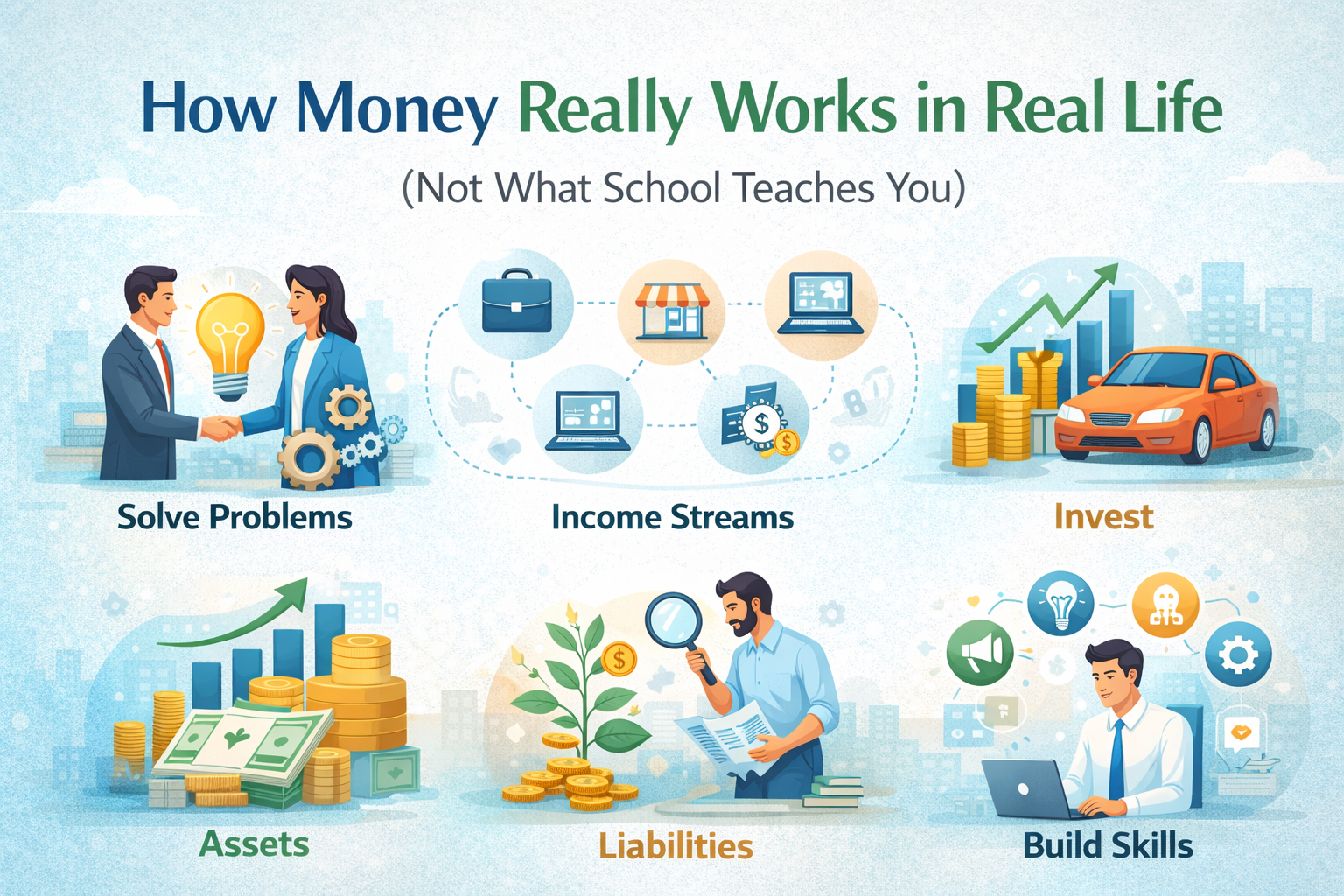
One of the most important lessons is that extraordinary wealth often comes from equity ownership, rather than simply earning a high salary.
6. Turn Ideas Into Large Companies
The common pattern is not simply having a good idea. The greatest fortunes were created by turning ideas into scalable companies and maintaining meaningful ownership as those companies grew.
Conclusion
The world's richest people come from different backgrounds and industries, but their stories share several common themes: innovation, entrepreneurship, ownership, scalability, persistence, investment, and long-term thinking.
From technology and artificial intelligence to e-commerce, luxury goods, software, and aerospace, enormous fortunes have been created by solving major problems and building companies capable of operating on a global scale.
The key lesson is simple: great wealth is usually created by building and owning valuable assets that can grow over time.
As the source notes, becoming extremely wealthy can involve technological